2026. 2. 18. 20:29ㆍ관심사의 input & output/음료 & 베이킹
📌 This post includes a full English version below.
You can use the Table of Contents to jump directly to the English section,
or simply scroll down to read the complete English version.
Table of Contents
제가 만들어서 먹어본 것 중 개인적으로 맛있어서 다음에 또 해먹어야겠다고 생각한 레시피만 공유합니다. 이번 르방 디스카드 크래커는 남는 사워도우 디스카드를 활용해 만드는 로즈마리 버전입니다. 재료는 단순하지만 공정을 정확히 지키면 얇고 바삭한 식감이 제대로 살아납니다.
르방 디스카드 로즈마리 크래커 재료
- 디스카드 180g
- 박력분 110g (중력분으로 대체 가능)
- 현미유 60g (다른 식물성 오일로 대체 가능)
- 말린 로즈마리 2g
- 소금 3g
르방 디스카드 크래커는 비율이 중요합니다. 디스카드 180g을 기준으로 박력분 110g, 현미유 60g의 균형이 맞아야 질지 않고 바삭한 구조가 나옵니다. 말린 로즈마리 2g은 향이 은은하게 올라오는 정도라 구웠을 때 부담 없이 즐기기 좋습니다.
르방 디스카드 크래커 만드는 방법
1. 디스카드 + 현미유 섞기
디스카드 180g과 현미유 60g을 먼저 충분히 섞어 오일이 고르게 퍼지도록 합니다. 이 단계에서 덩어리가 남지 않게 섞어두면 이후 반죽이 한결 수월해집니다.
2. 가루 + 시즈닝/로즈마리 넣고 뭉치기 (치대지 않기)
박력분 110g, 말린 로즈마리 2g, 소금 3g을 넣고 한 덩어리로 모이게만 섞습니다. 치대지 않는 것이 가장 중요합니다. 글루텐을 과하게 형성시키지 않아야 구웠을 때 단단해지지 않고 바삭하게 완성됩니다.
3. 둥글려 랩 → 냉장 40분
반죽을 둥글려 랩으로 감싼 뒤 냉장 40분 휴지합니다. 이 과정은 오일을 안정시켜 반죽을 단단하게 만들고, 이후 밀 때 갈라짐을 줄여줍니다.
4. 유산지 사이 1~1.5mm로 밀기
유산지 사이에 두고 1~1.5mm 두께로 얇게 밉니다. 두께는 반드시 이 범위를 지키는 것이 좋습니다. 두꺼우면 쿠키처럼 되고, 얇으면 더 크리스피한 식감이 납니다.

5. 포크로 구멍
표면에 포크로 고르게 구멍을 내줍니다. 굽는 동안 반죽이 과하게 부풀지 않아 평평하고 일정한 크래커가 됩니다.
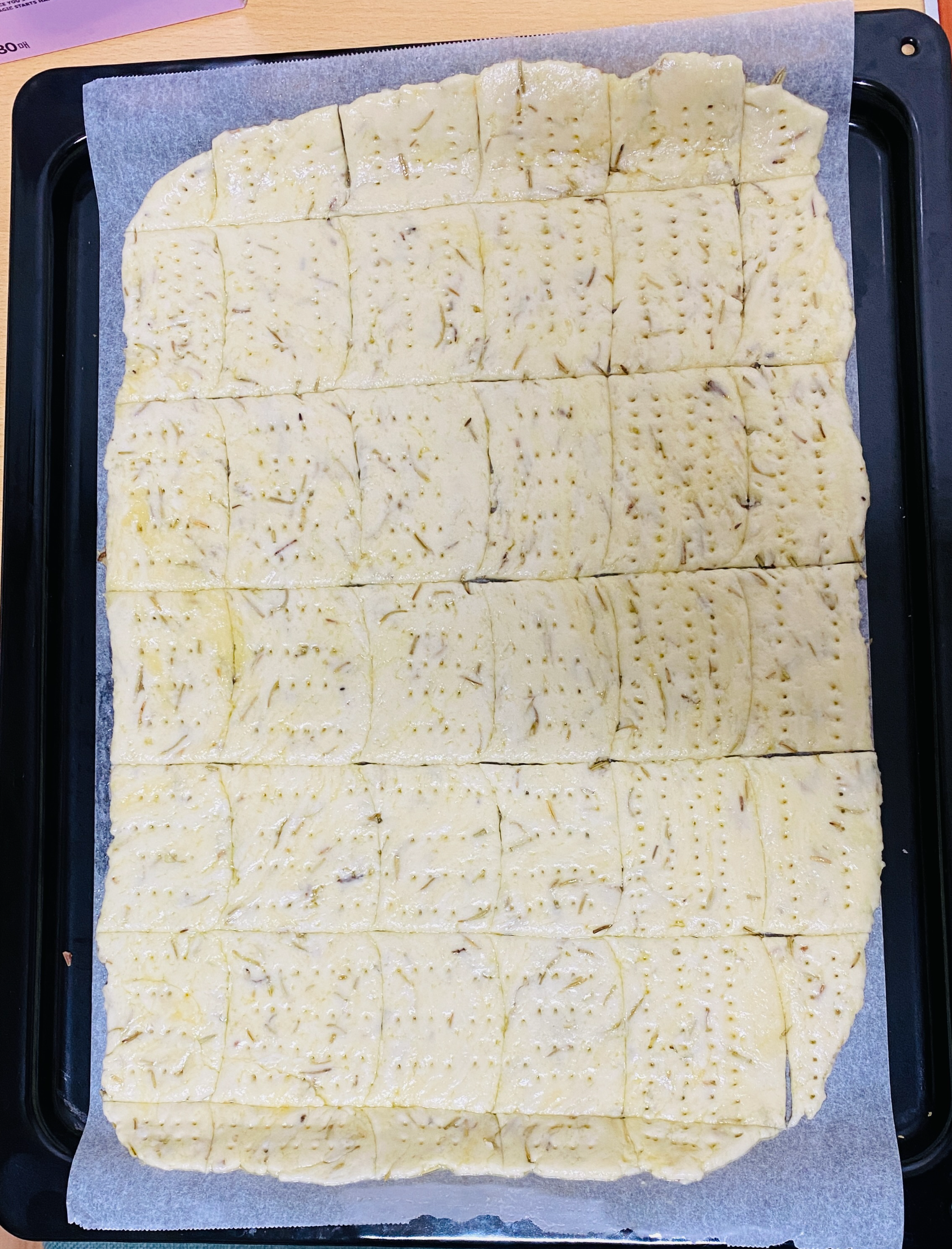
6. 160°C 22~28분
160°C에서 22~28분 굽습니다. 가장자리가 서서히 갈색을 띠기 시작하면 거의 완성 단계입니다. 오븐마다 편차가 있으므로 22분 이후부터 색을 확인합니다.

7. 불 끄고 문 살짝 열어 5~10분 더 말리기
불을 끄고 오븐 문을 살짝 열어 5~10분 더 두면 내부 수분이 빠지면서 훨씬 바삭해집니다. 이 과정을 거치면 르방 디스카드 크래커 특유의 고소함과 로즈마리 향이 더욱 또렷하게 살아납니다.

This post shares a rosemary version of levain discard crackers made with leftover sourdough discard. The ingredients are simple, but the texture depends on keeping the ratios steady and following the steps precisely. When you mix the oil well, avoid kneading, and roll the dough thin, you get crackers that bake up light, evenly crisp, and clean-tasting. This method is designed to help you use sourdough discard without turning it into something heavy or bready, and it works well as a basic template for other seasonings once you get the thickness and bake time right.
Levain Discard Crackers - Ingredients
- Sourdough discard (levain discard) 180g
- Cake flour 110g (all-purpose flour works as a substitute)
- Rice bran oil 60g (any neutral vegetable oil works)
- Dried rosemary 2g
- Salt 3g
For levain discard crackers, the texture is mostly a ratio game. Using 180g discard as the base, 110g flour and 60g oil gives a dough that isn’t sticky or slack, and it bakes into a crisp structure instead of something chewy. If you reduce the oil too much, the dough can feel dry and crack as you roll; if you increase it too far, the crackers can lose snap and brown unevenly. The 2g of dried rosemary is intentionally light—enough to come through after baking without dominating. Salt at 3g keeps the flavor balanced, especially because sourdough discard can vary slightly in tang depending on how mature it is. If your discard is very liquid, you may need a small dusting of flour during rolling, but try to keep the base measurements consistent first. Once you nail the thickness and bake time, this ingredient list becomes a reliable sourdough discard template you can repeat whenever you have extra discard to use up.
Levain Discard Crackers - How to make
1. Mix the discard and oil first
Combine 180g sourdough discard with 60g rice bran oil and stir until the oil is evenly distributed. Taking time here matters: when the oil is well-emulsified into the discard, the dough comes together faster later and rolls more evenly. Aim for a smooth mixture without visible oily streaks or large lumps.
2. Add the dry ingredients and gather (do not knead)
Add 110g cake flour, 2g dried rosemary, and 3g salt. Mix just until the dough comes together into one mass. The key is not kneading—overworking develops gluten, which can make the baked crackers firm and hard rather than thin and crisp. You’re looking for a cohesive dough that still feels tender.
3. Shape, wrap, and chill for 40 minutes
Form the dough into a round, wrap tightly, and refrigerate for 40 minutes. This rest helps the oil settle and firms the dough, which reduces tearing and cracking when you roll it out. It also makes it easier to reach a consistent thickness across the sheet.
4. Roll between parchment to 1–1.5mm
Place the dough between two sheets of parchment paper and roll it thin, aiming for 1–1.5mm. Staying in this range is important: thicker dough bakes more like a cookie and loses that clean snap, while thinner dough becomes extra crisp and light. Keep the sheet as even as possible so the crackers finish at the same time.
5. Dock with a fork
Prick the surface evenly with a fork. Docking prevents large bubbles from forming in the oven, helping the crackers stay flat and bake uniformly. This step is especially useful when working with sourdough discard, which can create steam pockets as it heats.
6. Bake at 160°C (320°F) for 22–28 minutes
Bake at 160°C for 22 to 28 minutes. When the edges slowly start turning golden brown, you’re close. Ovens vary, so begin checking color around the 22-minute mark and adjust as needed. For the best texture, you want a steady, dry bake rather than a fast, dark brown finish.
7. Turn off the oven and dry 5–10 minutes with the door slightly open
Turn off the heat and leave the crackers in the oven for another 5 to 10 minutes with the door slightly open. This extra drying step pulls out residual moisture and noticeably improves crispness. It also helps the nutty flavor of the levain discard and the rosemary aroma come through more clearly once cooled.
'관심사의 input & output > 음료 & 베이킹' 카테고리의 다른 글
| 제빵 기능사 필기 한 번에 붙은 후기 (단기 공부 방법) (0) | 2026.02.18 |
|---|---|
| [르방 활용 레시피] 르방 디스카드 머핀 (Sourdough Discard Muffins) (0) | 2026.02.18 |
| 틀로 찍어 만든 비건 쿠키 (하다앳홈님 레시피 후기) (2) | 2025.05.17 |